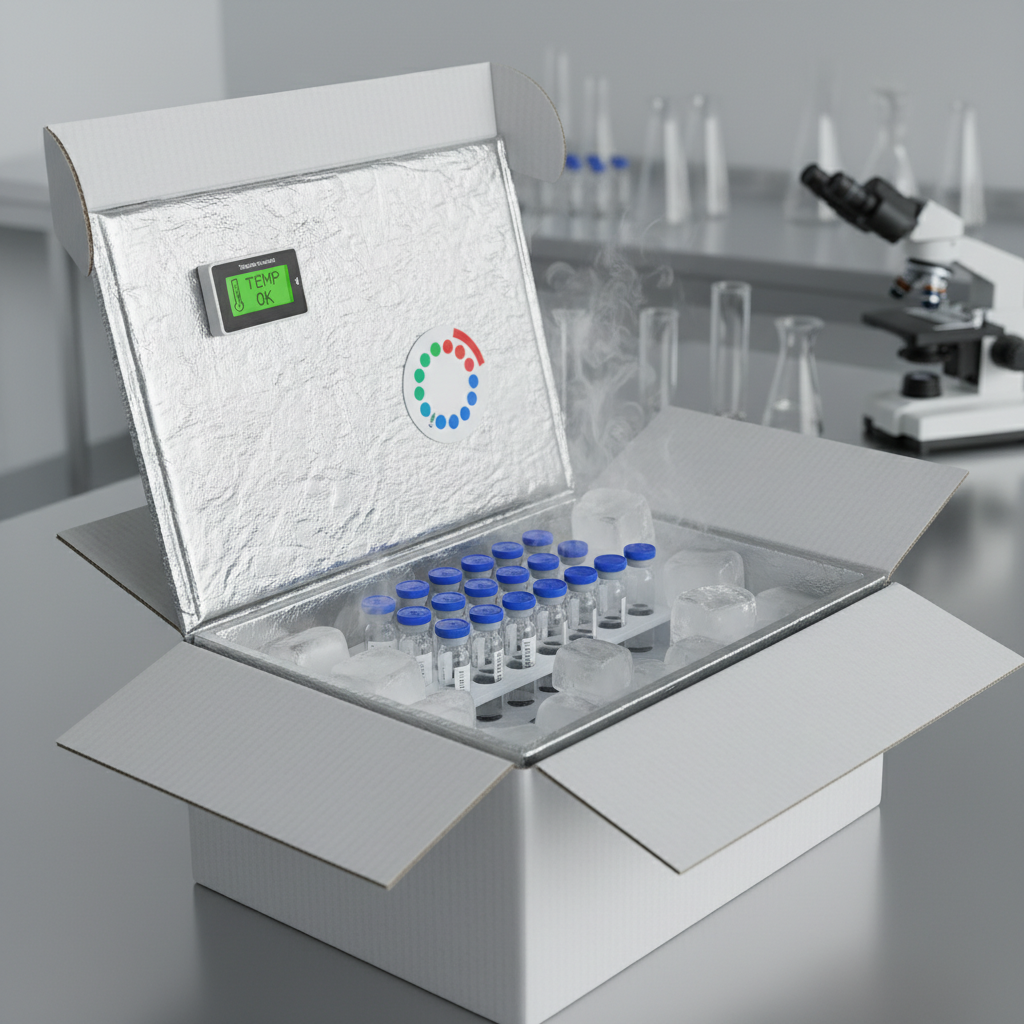
How Peptide Vendors Ensure Cold Chain Integrity During Shipping
A deep dive into cold chain logistics for research peptide shipping. Learn how vendors maintain temperature control, what packaging methods are used, and how to verify your shipment arrived in optimal condition.
Cold chain integrity — the unbroken maintenance of appropriate temperature conditions from warehouse to delivery — is a critical quality factor in research peptide sourcing. Peptides are biological molecules that can degrade when exposed to excessive heat, and the shipping process introduces temperature exposure that vendors must actively manage. This article examines the cold chain practices across the research peptide industry, the technologies vendors use, and how researchers can verify shipment quality upon receipt.
Why Cold Chain Matters for Peptides
Peptides are chains of amino acids connected by peptide bonds. While lyophilized (freeze-dried) peptides are significantly more stable than solutions, they are not immune to degradation during shipping. The primary concerns are:
Thermal degradation: Elevated temperatures accelerate chemical reactions that break down peptides. Deamidation (loss of amide groups from asparagine and glutamine residues), oxidation (particularly of methionine and cysteine), and hydrolysis can all occur during extended heat exposure.
Moisture absorption: Lyophilized peptides are hygroscopic — they readily absorb moisture from the environment. Humid conditions combined with temperature cycling (warm days, cool nights) can cause condensation inside packaging, initiating degradation reactions.
Physical damage: Temperature cycling can cause mechanical stress on lyophilized peptide cakes, potentially affecting dissolution behavior during reconstitution.
The practical impact of these factors depends on the duration and magnitude of temperature exposure. A peptide vial that sits in a hot mailbox for an hour is unlikely to suffer significant degradation. A package that spends three days in a delivery vehicle during a summer heatwave is a genuine concern.
Cold Chain Technologies Used by Vendors
Insulated Shipping Containers
The foundation of peptide cold chain management is insulated packaging that buffers external temperature changes.
Expanded Polystyrene (EPS) Foam: The most common insulation material. EPS foam coolers provide good thermal insulation at low cost. Most vendors use EPS foam liners inside standard shipping boxes, creating an insulated cavity for the product and cold packs.
Reflective Bubble Wrap: Some vendors use reflective foil-lined bubble wrap as a secondary insulation layer inside or outside the EPS foam. The reflective surface reduces radiant heat transfer, while the air pockets provide additional insulation.
Vacuum Insulated Panels (VIPs): Premium insulation technology used by a few high-end vendors. VIPs provide dramatically better insulation per unit thickness than EPS foam but at significantly higher cost. Their use is typically reserved for high-value shipments or extreme weather conditions.
Phase-Change Material (PCM) Pouches: An emerging technology in the research chemical shipping space. PCM pouches absorb and release thermal energy at specific temperatures (e.g., maintaining 2-8 degrees C), providing more precise temperature control than conventional ice packs. Some vendors have begun incorporating PCM technology into their premium shipping options.
Refrigerants
Gel Ice Packs: The most common cold chain element. Gel packs are frozen before shipment and placed alongside the product inside the insulated container. Standard gel packs maintain a cool environment for 24-48 hours depending on external temperature, insulation quality, and the number of packs used.
Dry Ice: Provides more aggressive cooling (sublimation temperature of -78.5 degrees C) and longer cold chain duration. However, dry ice requires special handling, is classified as a hazardous material for shipping purposes, and is more expensive. Its use is generally reserved for reconstituted peptide solutions or extremely temperature-sensitive compounds.
Frozen Water Bottles: A budget approach used by some smaller vendors. Less effective than gel packs due to the rigid container shape (which limits contact with the product), but provides basic cooling.
Temperature Monitoring
Thermal Indicator Strips: Paper or sticker-based indicators that change color irreversibly when a threshold temperature is exceeded (e.g., 25 degrees C, 30 degrees C, or 37 degrees C). These provide a simple pass/fail indication of whether the shipment experienced excessive heat. Cost is minimal (under $1 per unit), making them feasible for inclusion in every shipment.
Digital Temperature Loggers: Electronic devices that continuously record temperature throughout the shipping process, producing a time-stamped log that can be reviewed upon receipt. These provide much more detailed information than indicator strips — showing not just whether a threshold was exceeded but the actual temperature profile over time. Cost ($5-$20 per unit) limits their use to premium or high-value shipments.
Smart Labels with NFC/QR: An emerging technology where temperature-sensing labels transmit data to a smartphone app when scanned. These combine the low cost of indicator strips with the data richness of digital loggers.
Vendor Cold Chain Practices
Premium Cold Chain Programs
Ascension Peptides packages all orders in custom EPS foam containers with dual gel ice packs. Their same-day shipping minimizes total transit time. During summer months (June-September), they automatically upgrade to enhanced thermal packaging at no additional cost. Thermal indicator strips are included in all shipments.
Limitless Biotech uses insulated containers with gel packs for all shipments. Their US-only shipping policy means shorter transit times, which reduces temperature exposure risk. They offer a "summer shipping" option with additional cold packs and priority carriers during warm months.
Standard Cold Chain Practices
Swiss Chems provides insulated packaging with gel packs for domestic orders. For international shipments, enhanced thermal packaging is used to account for longer transit times. They recommend express shipping during summer months and will hold orders upon request if extreme heat is forecast.
Core Peptides includes gel packs and insulated packaging in all orders. They monitor weather conditions at the destination and will proactively delay shipping if extreme heat events are expected, notifying the customer of the delay.
Basic Cold Chain Practices
Bioinfinity and Amino Asylum provide basic insulated packaging with gel packs for most orders. Summer shipping upgrades may be available upon request or for an additional fee.
Seasonal Considerations
Summer Shipping (June - September in Northern Hemisphere)
Summer presents the greatest challenge for cold chain integrity. Recommendations for warm-weather ordering:
- . Upgrade shipping speed. Overnight or 2-day shipping significantly reduces heat exposure compared to standard ground shipping.
- . Request enhanced packaging. If your vendor offers a summer shipping option, use it.
- . Coordinate delivery. Ensure someone is available to receive the package promptly. Do not allow packages to sit in mailboxes, on porches, or in lobbies during hot weather.
- . Ship early in the week. Packages shipped Monday-Wednesday are less likely to spend a weekend in a hot warehouse or delivery vehicle.
- . Consider holding orders. If extreme heat events are forecast (temperatures above 100 degrees F / 38 degrees C), consider delaying your order until conditions moderate.
Winter Shipping
While less commonly discussed, extreme cold can also affect peptides. Freezing during shipping is generally not a concern for lyophilized peptides (they are already dry), but repeated freeze-thaw cycling of poorly insulated packages can cause physical stress. Reconstituted peptide solutions should not be shipped in freezing conditions without appropriate packaging.
Verifying Cold Chain Integrity Upon Receipt
Immediate Inspection
- . Check cold packs. Are they still cool? If gel packs are completely warm and the ambient temperature has been hot, the cold chain may have been broken for an extended period.
- . Check thermal indicators. If included, verify they have not been triggered.
- . Inspect product appearance. Lyophilized peptides should be a white to off-white powder or compact cake. Discoloration, transparency, or sticky residue may indicate degradation.
- . Check for moisture. Condensation inside the vial suggests moisture exposure, which is a concern for lyophilized products.
Functional Verification
For critical research, consider HPLC testing of received products to verify purity matches the COA. This is the definitive way to confirm that shipping conditions did not compromise product quality.
Documentation
Photograph the package contents upon receipt, including cold pack condition and thermal indicator status. This documentation is essential if you need to file a shipping damage claim with the vendor.
Conclusion
Cold chain management is an area where vendor quality varies significantly. Premium vendors invest in robust packaging, seasonal protocols, and temperature monitoring that protect product integrity during transit. Budget vendors may provide basic insulation that is adequate under favorable conditions but insufficient during extreme weather. Researchers should factor cold chain practices into their vendor evaluation, particularly if they are located in regions with extreme temperatures or ordering during summer months.
All products discussed are for research purposes only. Not for human consumption.
Disclaimer: All products referenced in this article are intended for laboratory and research use only. They are not intended for human consumption. This article is for informational purposes and does not constitute medical, legal, or professional advice. This site may receive compensation through affiliate partnerships with vendors mentioned.