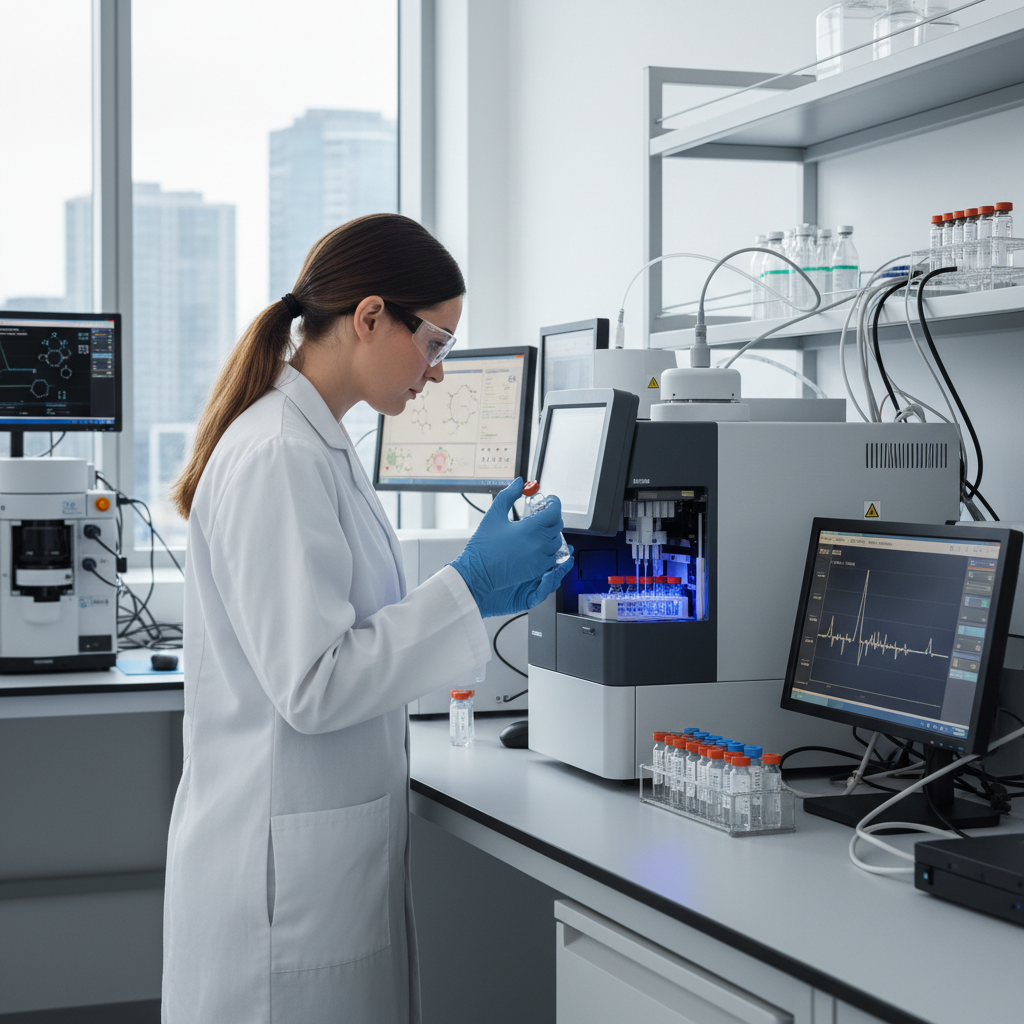
Lab Tested Research Peptides: How Independent Peptide Analysis Labs Work
What "lab tested" should mean on a research peptide listing, which analysis services peptide labs offer, how independent labs like Janoshik and contract analytical providers differ, and how to check a lab report before you trust it.
Lab tested peptides are research peptides whose specific batch has been analyzed by a named laboratory, at minimum HPLC for purity and mass spectrometry for identity, with a report you can trace back to that lab and match to the lot number on your vial. Many listings use the phrase loosely. Some mean an in-house HPLC run, some mean a third-party report from months ago on a different lot, and some mean nothing you can check. This guide explains which peptide analysis services exist, how the labs that perform them differ, and how to read a "lab tested" claim before you rely on it.
What "Lab Tested" Should Mean on a Peptide Listing
A useful lab tested claim answers four questions:
- Which lab? A named laboratory, not "an independent facility."
- Which batch? A batch or lot number that matches the vial label.
- Which tests? At minimum, purity by HPLC and identity by mass spectrometry.
- Can it be checked? A report number, QR code, or lab contact that lets you confirm the document is real.
If a vendor cannot answer all four, the claim tells you little. For the background on what each method measures, see our guide to HPLC, mass spec, and amino acid analysis.
Three Kinds of Peptide Labs
Searches for "peptide labs" return three very different types of business, and it helps to keep them apart.
Vendor in-house labs
Some vendors run their own HPLC and publish the results as a certificate of analysis (COA). In-house data is useful for routine quality control, but the lab and the seller are the same company, so the result is not independent. Our explainer on third-party testing covers why that distinction matters.
Contract analytical labs
These are commercial service providers that test peptides for companies, universities, and development programs. They usually publish a menu of methods and work under formal quality systems. Biosyn, a peptide company in Texas, is one example. Its analytical services page lists analytical HPLC, MALDI-TOF and LC-MS, amino acid analysis, counterion analysis, and endotoxin assays, and states that the work is "aligned with GLP / ISO 13485 quality systems for regulated non-GMP needs" while noting that GMP manufacturing is not offered.
Independent labs used by the research peptide market
A small number of labs have become the default third-party option for the gray-market research peptide space. Vendors send them samples, and so do individual buyers who want to check a product they received. Janoshik Analytical is one of the most frequently cited names. These labs fill a real gap, but their standards vary, and they are not the same as a regulated contract lab.
Peptide Analysis Services Explained
Whichever lab you look at, the service menu is built from the same building blocks.
Purity by HPLC
High-performance liquid chromatography separates the sample into components and reports the main peak as a percentage of the total. It is the standard purity test, but it has limits. A Peptide Journal guide to third-party testing notes that HPLC "measures relative purity among UV-absorbing compounds," so salts, water, and counterions do not show up, and impurities can hide under the main peak. As the same guide puts it, "HPLC tells you something is there, not what it is."
Identity by mass spectrometry
Mass spectrometry measures molecular mass and confirms that the main component is the peptide on the label. MALDI-TOF gives a fast intact mass check, while LC-MS combines separation with mass data in one run. A purity number without an identity check can describe a highly pure sample of the wrong compound.
Amino acid analysis and net peptide content
Amino acid analysis breaks the peptide into its building blocks and quantifies them. It helps establish how much peptide is actually in the vial, as opposed to salts and moisture. Biosyn describes it as useful "when UV response may not reflect true mass."
Counterions, endotoxins, and contaminants
Synthetic peptides usually carry counterions such as TFA or acetate from purification. Counterion analysis measures them. Endotoxin testing, heavy metals screening, and residual solvent analysis are add-ons that matter most for cell culture and animal model work. Few vendors publish these routinely, so their presence on a COA is a good sign.
Janoshik Analytical: What Public Sources Say
Because so many vendors cite Janoshik reports, it is worth knowing what is publicly reported about the lab. A detailed public review of Janoshik describes it as based in Prague, Czech Republic, with HPLC as its primary method and LC-MS and GC-MS used for identity and contamination screening. The same review reports:
- Verification: each report carries a unique key and QR code that can be checked against Janoshik's public database, which has caught at least one altered vendor COA.
- No ISO/IEC 17025 accreditation: the review calls this the most persistent criticism, and notes that results would not suit regulatory submissions.
- Limited report detail: methodology is often omitted and raw chromatographic data is not included by default.
- Selection bias: vendors are paying clients and choose which results to publish, so a page full of good reports may not represent every batch.
The review's overall view is that Janoshik is a practical option in an unregulated market, not a substitute for pharmaceutical quality control. That is a fair way to read any vendor's "tested by Janoshik" badge: a useful signal when the report key verifies and matches your batch, and a weak one when it does not.
Why Accreditation Matters: ISO/IEC 17025
ISO/IEC 17025 is the international standard for "the competence of testing and calibration laboratories." According to its Wikipedia summary, labs are accredited against it by a national accreditation body that assesses their technical competence for a defined scope of tests, and many regulators and suppliers will not accept results from unaccredited labs.
For research peptide buyers, accreditation means:
- The lab's methods have been validated and its equipment calibration is audited.
- The accreditation covers specific tests, so check that peptide HPLC or MS is within the scope, not just some other service the lab offers.
- An accredited lab can still produce a report you cannot verify if the vendor edits the PDF, so accreditation and verifiability are separate checks.
Most labs serving the research peptide market are not accredited. That does not make their results wrong, but it shifts more of the checking onto you.
How to Check a "Lab Tested" Claim in Five Steps
- Match the batch. Compare the lot number on the COA with the lot number on your vial. A report on a different batch says nothing about yours.
- Identify the lab. Look for a lab name, address, and report number. Reports with only a vendor logo are in-house data.
- Verify the report. Use the lab's QR code or online lookup if it has one, or email the lab with the report number. Labs that offer this are more accountable than those that only issue static PDFs.
- Read the data, not just the number. A chromatogram, the observed versus expected mass, the test date, and the method details all belong on a good report. A bare "99.1%" without supporting data is not enough.
- Check the date. Peptides degrade, and a report from long before your order may not reflect what ships today.
Our guide to verifying peptide purity goes deeper on reading chromatograms and spotting red flags, and the vendor transparency report grades which vendors publish this documentation openly. To line up several vendors' reports side by side, use the checklist in how to compare peptide lab records.
How to Choose a Peptide Analysis Laboratory
If you want a peptide testing lab to analyze a sample yourself, rather than relying on the vendor's report, compare labs on the points that change what the result is worth:
- Who it accepts samples from. Some labs work only with companies and institutes; others take single samples from individual buyers.
- Which methods it runs. HPLC alone gives purity only. Look for mass spectrometry for identity, and amino acid analysis if you need net peptide content.
- How reports are verified. A report key, QR code or public lookup lets anyone confirm the document was issued as shown.
- Accreditation scope. If the lab is ISO/IEC 17025 accredited, check that peptide methods are inside the scope.
- Published pricing and turnaround. Labs that state their prices and timelines up front are easier to plan around.
Location matters less than these points, but it does affect shipping time and customs. We list options by region in peptide testing labs in the USA and peptide testing labs in Europe.
How Vendors We Cover Describe Their Testing
Based on what each vendor publishes, as summarized in our vendor profiles:
- Sports Technology Labs states that its peptides are tested by independent laboratories for purity and identity, with results published by batch number, and that select products are also tested for endotoxins and heavy metals.
- Limitless Biotech describes in-house HPLC followed by third-party verification, with a batch COA linked on each product page.
- Ascension Peptides publishes HPLC and mass spec COAs by batch, supplemented by periodic third-party checks.
- Core Peptides and Bioinfinity provide batch COAs and run third-party testing on a rotating or periodic basis.
In every case, apply the five steps above to the specific report for the batch you receive. A vendor's general testing policy is a starting point, not proof.
Common Questions
Are "peptide labs" the same as peptide vendors?
Not usually. Many vendors use "labs" in their brand name, but that does not mean they operate an analytical laboratory. Look for who actually produced the COA.
Should I look for peptide labs in the USA?
A US lab can be easier to reach and ship samples to, but location says nothing about method quality. Accreditation scope and a verifiable report matter more. Our comparison of peptide testing labs in the USA lists the US options with their methods and published prices. For the shipping and legal side of the domestic question, see domestic vs international peptide vendors.
Are there peptide testing labs in Europe?
Yes. Janoshik Analytical in Prague is the European lab most cited in this market and takes samples from individuals, while labs such as FILAB in France and JPT in Berlin offer wider methods mainly to companies and institutes. Our guide to peptide testing labs in Europe compares their methods, accreditation, prices and intake.
Can a buyer send a sample to a lab directly?
Yes. Independent labs in this market accept samples from individuals as well as vendors, and buyer-submitted tests are one of the few checks that do not depend on the vendor choosing what to publish. Confirm the lab's sample requirements and methods before sending. Our step-by-step guide on how to send a sample to a peptide testing lab covers packing, paperwork and reading the result.
Are lab tested peptides the same as third-party tested peptides?
Not always. "Lab tested" can describe an in-house HPLC run by the seller. "Third-party tested" means a lab separate from the seller produced the report. The second is the stronger claim, provided the report names the lab and can be verified.
What does a peptide analysis service cost?
It depends on the lab and the methods ordered. A single HPLC purity run is the cheapest option; adding mass spectrometry, amino acid analysis or endotoxin testing raises the price. Check each lab's current price list, since fees change and vary by region.
Is one passing report enough?
No. One report covers one batch on one date. Consistent, verifiable reports across several batches are a much stronger signal than a single impressive number.
All products discussed are for research purposes only. Not for human consumption.
Disclaimer: All products referenced in this article are intended for laboratory and research use only. They are not intended for human consumption. This article is for informational purposes and does not constitute medical, legal, or professional advice. This site may receive compensation through affiliate partnerships with vendors mentioned.