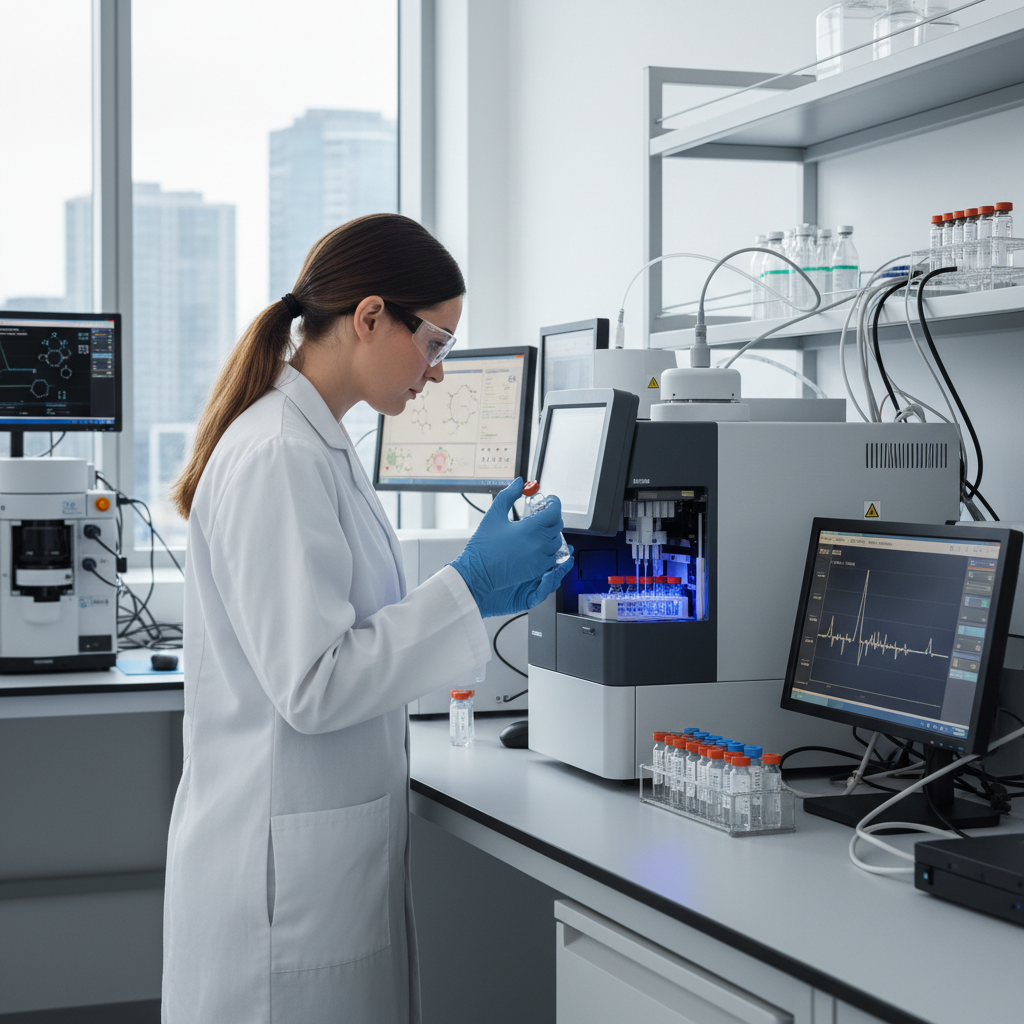
Research Peptide Labs: How Peptides Are Made and Who Makes Them
What a research peptide lab actually does: solid-phase synthesis, HPLC purification, freeze-drying, and how bulk powder from a synthesis lab becomes a vendor's labelled vial.
A research peptide lab, in the sense most buyers mean, is the synthesis laboratory that builds the peptide chain, purifies it and freeze-dries it into the white powder that ends up in a vial. That lab is often not the company whose name is on the label. Many research peptide vendors buy finished peptide in bulk from a manufacturer, split it into vials and sell it under their own brand, then have batches tested by an analytical lab. So three kinds of "peptide labs" sit behind one product: the synthesis lab, the vendor, and the testing lab.
This guide explains the first of the three: how peptides are made in a laboratory, what can go wrong at each step, and what a buyer can check. For the testing side, see our guide to lab tested peptides and independent analysis labs.
Three Kinds of Peptide Labs
Searches for "lab peptides", "peptide laboratory" or "research peptides lab" mix up three different businesses:
- Synthesis labs (manufacturers). They make the peptide from amino acids, purify it and dry it. Some are large contract manufacturers that serve drug developers; others supply bulk powder to the research market.
- Vendors. They buy, store, package, label and ship. A vendor with "Labs" in its name may or may not run its own synthesis. Few vendors state their manufacturing source on their websites.
- Analytical labs. They test a sample and issue a certificate of analysis (COA). Examples on our site include the labs in our USA testing labs guide and the European testing labs guide.
Knowing which one you are looking at tells you which claims each can actually back up. A vendor can show you a COA; only the synthesis lab knows the full production record.
Step 1: Building the Chain With Solid-Phase Synthesis
Almost all research peptides are made by solid-phase peptide synthesis (SPPS). ChemPep's overview of peptide synthesis explains that "Historically, peptide synthesis was performed entirely in solution," until Merrifield introduced the solid-phase method in 1963.
In SPPS, "The growing peptide chain is covalently attached to an insoluble polymeric support (resin)." Amino acids are added one at a time. After each addition, excess reagents are washed away, which is what makes the method fast and suited to automation.
Each amino acid arrives with a protecting group on its reactive end so that only one bond forms per step. The two common chemistries are named after those groups:
- Fmoc chemistry. The Fmoc group "is base-labile (removed by piperidine)." This is the standard approach in most modern labs because the final cleavage uses milder acid.
- Boc chemistry. The Boc group "is acid-labile (removed by TFA)," and the final cleavage needs much harsher acids such as HF.
When the chain is complete, "the peptide is cleaved from the resin, and all remaining side-chain protecting groups are simultaneously removed." Liquid-phase synthesis still exists, and ChemPep describes it as suited to kilogram-scale work, but SPPS dominates the research market.
Why chain length matters
No coupling step is perfect. ChemPep gives the example that a 99% success rate per step leaves only about 37% full-length chains for a 100-residue peptide. Most research peptides are far shorter than that, but the principle holds: every extra residue adds a chance for a missing or truncated sequence. That is why longer peptides tend to cost more and why purification is not optional.
Step 2: Purification by HPLC
What comes off the resin is not yet a product. Bachem, a Swiss peptide manufacturer, states in its peptide purification overview that "the cleavage process produces a crude product that contains the desired peptide alongside various impurities." It lists those impurities as "deletion peptides, truncated peptides, incompletely deprotected peptides, modified peptides, residual reagents" and related by-products.
Bachem calls reversed-phase high-performance liquid chromatography (RP-HPLC) "The standard method for peptide purification." The crude peptide runs through a column packed with C18-modified silica, and the components separate by how hydrophobic they are. A UV detector at 210 to 220 nm shows each peak. Fractions are collected, checked by analytical HPLC, and only those that meet the purity target are pooled.
This is the same technique that later shows up on a COA as an HPLC purity figure. The difference is scale: the synthesis lab uses preparative HPLC to separate the product, and the testing lab uses analytical HPLC to measure how pure the result is.
The salt that comes with it
The HPLC mobile phase usually contains trifluoroacetic acid (TFA), so most research peptides end up as TFA salts. Bachem notes that "These salts cannot be removed during purification but do not affect the quality of the final peptide." Some suppliers offer acetate or other salt forms through an extra exchange step. If a COA lists the peptide content separately from purity, the counterion is one reason the two numbers differ; our guide to understanding peptide vendor lab testing explains that distinction.
Step 3: Freeze-Drying Into Powder
According to Bachem, "Once purified, the peptide is obtained as a solution, which is then lyophilized to remove the solvent and produce a fine white powder." Lyophilization (freeze-drying) freezes the solution and removes water and solvent under vacuum.
It is slow work. A Manufacturing Chemist article, sponsored by an equipment supplier, notes that "the lyophilization process itself can be time-consuming, sometimes requiring days to achieve the desired sample dryness." It also explains why the acetonitrile and TFA in pooled HPLC fractions complicate drying.
The result is the stable powder that research peptides ship as. Dry powder resists most forms of degradation far better than a solution, which is why storage advice centres on keeping it dry and cold. See our peptide storage best practices for the details.
Step 4: From Bulk Powder to a Branded Vial
This is the step most buyers never see. A supply chain overview from an industry guide site describes the common model: "vendors buy lyophilized peptide in bulk quantities (typically kilogram-scale) from manufacturers," mostly located "primarily in China, with smaller operations in Slovakia, Cyprus, Spain, and Vietnam." It adds that "vendors are often purchasing from the SAME manufacturers as their direct competitors."
That page is an affiliate site and gives no sources for those statements, and it notes itself that manufacturer relationships are rarely disclosed. Read it as a description of the common model rather than a map of who supplies whom.
What follows the bulk purchase matters more than the origin. According to the same overview, reputable vendors split the powder into vials and "run their own testing (HPLC + LC-MS minimum, occasionally deeper)," often through a third-party lab. That testing step is where the buyer gets visibility. Two vendors buying from the same synthesis lab can still differ on whether they test each incoming batch, how they store it and whether the COA matches the vial you receive.
What a Buyer Can Check
You cannot audit a synthesis lab from a product page, but you can check the trail it leaves:
- Ask about sourcing. Does the vendor synthesize in-house or buy from a contract manufacturer? A clear answer is a good sign; our guide to new peptide vendors lists the questions to ask.
- Look for identity and purity. HPLC measures purity. Mass spectrometry confirms the peptide is the right molecule. A COA with both covers the two biggest synthesis risks: impurities and a wrong or incomplete sequence.
- Match the batch. Each synthesis run is a batch. The lot number on the COA should match the lot on your vial. The COA transparency report compares how vendors handle this.
- Check who ran the test. A named third-party lab with a verifiable report is stronger than an unnamed in-house result. See how to verify peptide purity.
- Look at the physical product. A lyophilized peptide should be a dry white or off-white cake or powder. Moisture or discoloration points to a handling problem after the synthesis lab.
Sports Technology Labs is one example of a vendor that puts its testing in public view: it posts third-party HPLC certificates on a public COA page, so a buyer can read the purity result for a product before ordering. Our domestic vs international vendors guide covers what a US shipping address does and does not tell you about where a peptide was made.
Common Questions
Is a vendor with "Labs" in its name a laboratory?
Not necessarily. The name describes the brand. Whether the company runs synthesis, testing or neither is something its website or support team has to state.
Where are most research peptides made?
Industry overviews describe most research-grade peptide synthesis as taking place in China, with smaller manufacturers in Europe and Asia. Individual vendors rarely name their manufacturer, so the batch COA is the practical quality signal.
Does the synthesis lab or the testing lab issue the COA?
Either can. A manufacturer's in-house QC lab often issues a certificate with the bulk batch, and many vendors then commission a third-party lab to test the vialed product. A third-party report is the more independent of the two.
Why are some peptides more expensive to make?
Length, difficult sequences and modifications all add synthesis steps and lower yield, and purification to a higher purity target discards more material. Our pricing comparison shows how this plays out across vendors.
All products discussed are for research purposes only. Not for human consumption.
Disclaimer: All products referenced in this article are intended for laboratory and research use only. They are not intended for human consumption. This article is for informational purposes and does not constitute medical, legal, or professional advice. This site may receive compensation through affiliate partnerships with vendors mentioned.